Whale Watch: Profiles on All Your High Rollers
A handful of fans drive most of your income. Whale Watch keeps a profile on every one of them so you always know who your high rollers are, what they respond to, and when it is time to reach out.
Quick answer: Whale Watch tracks every tipper and builds a profile on the ones who matter, total spent, average tip, follow length, platform, and last-tipped date, then ranks them by value. That ranked view is how you stop relying on memory and start treating your top supporters like the high rollers they are. Here is how to build one and what each number is telling you.
The 80/20 rule of cam income
After enough time on cam, one pattern becomes impossible to ignore: a small slice of your fans, often the top five percent, accounts for the large majority of your income. These are your whales and your loyal regulars, and they are the difference between a good month and a great one.
Treat them like VIPs and they stay. Let them feel like just another username in the room and they will quietly wander off to a stream where they feel seen. The stakes are high precisely because there are so few of them.
Why your memory is not a system
During a busy stream, a tipper drops a big tip and then vanishes for two weeks. You meant to follow up. But there were a dozen other things happening, and now you cannot quite remember their name, how much they usually spend, or when you last heard from them.
That is not a discipline problem, it is a tooling problem. Human memory was never built to track dozens of relationships and their spending history. Without a system to catch it, every forgotten whale is real money left on the table.
The metrics that actually matter
A good fan profile is not a pile of numbers. It is a few signals that each tell you something you can act on:
- Total tips received: the single best measure of a fan's value, and the right way to rank them.
- Average tip amount: tells you how they like to spend. A high average points to someone who responds to high-ticket shows and goals; a steady stream of smaller tips points to a slow-burn regular who values attention and consistency.
- Follow length: how long they have been with you. Long-time fans deserve a different tone than someone who found you last week.
- Last-tipped date: your wake-up clock. The moment a reliable tipper goes quiet, this is the number that flags it.
- Platform: knowing where a fan came from keeps your branding and your outreach consistent across the sites you stream on.
Building the profile
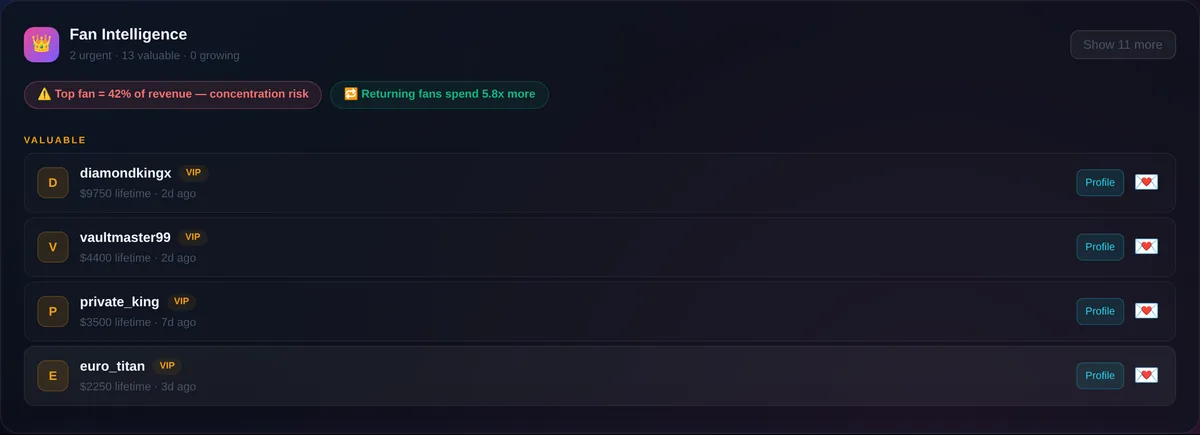
Put those signals together for every fan and rank the list by total tips, and you get something powerful: a standing, ordered view of exactly who your supporters are and what they are worth. Your biggest whale sits at the top. The regular who just went quiet is easy to spot. The newcomer who is tipping above average and might become your next VIP does not get lost.
You can see your ranked supporters in the top tippers view, right alongside the rest of your earnings data.
From data to DM: personalized re-engagement
The profile is not just for looking at. When a fan goes quiet, the data behind their profile drives a personalized, copy-paste re-engagement message, one that references their actual history with you instead of a generic blast. You drop it into the right platform inbox and it lands like you genuinely remembered them, because the system did the remembering for you.
That saves hours of manual DMing and makes every message feel personal. For the full strategy on what to say and when, including timing and tone, see our deep dive on re-engaging whales and top tippers.
The psychology: perceived relationship value
Here is why all of this works. Fans do not spend the most where the show is objectively best. They spend the most where they feel recognized, remembered, and valued. The technical term is perceived relationship value, and it is the real engine behind a loyal, high-spending fanbase.
Whale Watch is how you scale that feeling. When you can greet a returning whale by name, reference the goal they helped you hit last month, and reach out at exactly the right moment, you are manufacturing the sense of being seen, the same thing that keeps people coming back. The mechanics of turning that into lasting loyalty are covered in how to build loyal fans.
Getting started
- Create your free account at camcashgrl.com.
- Track tips automatically with the CamCashGrl extension so profiles build themselves as you stream.
- Backfill earlier fans with a one-time CSV import if you want their full history.
- Open your top tippers view, sort by value, and start treating your VIPs like VIPs.
You do not have to remember every whale. You just need a system that does.

Pretty Profitz's VIP Client Tracker is a fillable PDF workbook for logging your top clients — spending history, preferences, follow-up reminders, and re-engagement notes — no software required.
Use code PRETTY70 at checkout for 70% off.
Shop the VIP Client Tracker on Etsy →