How to Increase Cam Earnings Using Data (Not Guesswork)
Most cam models approach their income the same way: stream consistently, engage your audience, hope it works. The models who actually grow their income over time aren't just working harder — they're using their data. This guide breaks down exactly how.
Why Most Cam Models Leave Money on the Table
Cam modeling generates a significant amount of data — every tip, every session, every hour streamed creates a record. But almost no one uses it.
Most models know roughly how much they made last month. Very few know:
- Which specific hours generate 2–3x more revenue than others
- Which fans are responsible for 60–70% of their income
- Whether their streams tend to improve or decay after the first 30 minutes
- Which platform actually pays more per hour when normalized for session length
Without this information, you're running your business on feel. You might be scheduling streams at the wrong time, spending energy on the wrong platform, or letting high-value fans go cold without realizing it.
Step 1: Track Every Tip Across Every Session
The foundation of data-driven cam income is complete tip tracking — every tip, every session, every platform. Not just your good nights.
What to track
- Username, amount (tokens and/or USD), and timestamp for every tip
- Which platform the tip came from
- Session start and end time
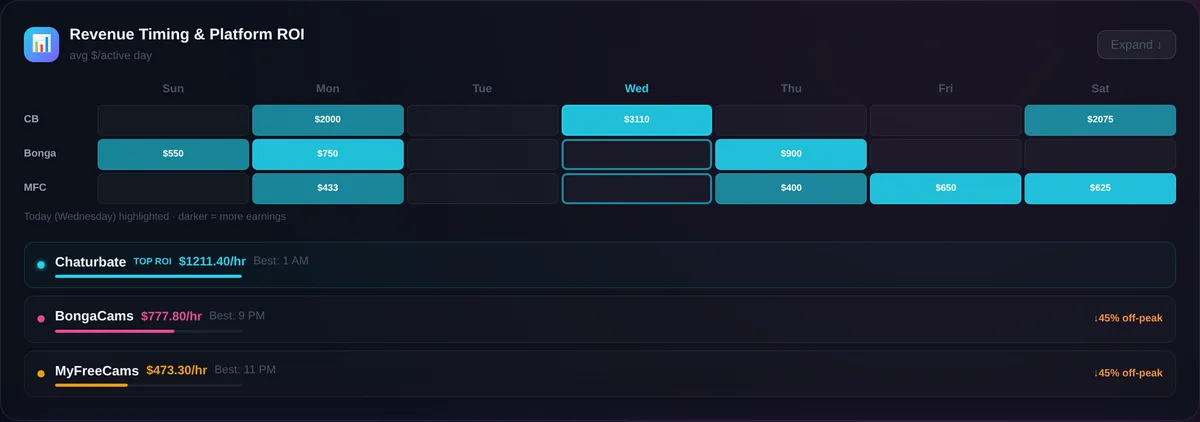
When you have complete tip history, patterns emerge. You'll see that specific fans tip on specific days. You'll see that Tuesday sessions consistently outperform Friday sessions. You'll see that one platform generates $18/hr while another generates $6/hr.
Tip: Export your CSV from Chaturbate or BongaCams and upload it to CamCash — it processes your full tip history and shows all of this in one dashboard.
You can't optimize what you don't measure — automate your tip tracking so the data is always current.
For a hands-on workbook system, the Chaturbate Earnings Tracker provides structured worksheets for session tracking, pattern analysis, and goal-setting organized in one resource. If you want a complete system that combines tracking with strategy planning and performance testing, the Chaturbate Earnings Growth Bundle integrates everything into one comprehensive toolkit.
Step 2: Find Your Real Peak Hours
The most common tip for increasing cam earnings is "stream at peak traffic times." The problem is that generic peak hours are based on platform-wide traffic — not your specific audience.
Your top fans have their own schedules. A model whose biggest tippers are in Europe will have completely different peak hours than one whose audience is primarily US-based.
How to find your peak hours
- Export at least 3 months of tip history from your platform
- Group your tips by hour of day
- Calculate average earnings per active streaming day at each hour
Most models find 2–3 hours where they earn 40–80% more than their overall average. Shifting your schedule to hit these windows is the single highest-leverage change you can make to increase cam earnings without changing anything else.
Step 3: Identify and Protect Your High-Value Fans
In almost every cam model's earning history, a small number of fans generate a disproportionate amount of revenue. Typically, the top 10–15% of fans account for 60–70% of total income. These are your whales. Losing one can cost you $50–$300+ in a month.
What to track per fan
- Lifetime spend in USD
- Number of tips and average tip size
- Average days between tips
- Days since last tip
- Risk level based on their typical tipping pattern
When a high-value fan's gap since last tip exceeds their average interval, it's time to reach out. A personalized message has a much higher re-engagement rate than a generic note.
Your regulars drive most of your income, so build profiles on your top tippers (Pro feature — upgrade after signup) and treat them like VIPs. For a dedicated workbook system, the VIP Client Tracker provides templates for whale profiles, spending history, gap notifications, and re-engagement messaging all in one organized resource.
Step 4: Analyze Every Session Like a Business
After each stream, ask three questions:
Did I earn above or below my average?
Not in absolute terms — in relative terms. A $40 session might be great if your average is $25, or poor if your average is $65. Knowing your benchmark makes every session meaningful data instead of just a number.
When did the money come in?
Was it front-loaded (big tips early, then dying off)? Back-loaded (slow start, then a rush)? Each pattern calls for a different strategy.
Who drove the revenue?
If one fan contributed 50%+ of a session's income, that's a concentration risk. Focus on engaging multiple tippers rather than depending on one.
When a room goes quiet, live AI coaching hands you the next move before the energy dies.
Step 5: Compare Your Platforms Honestly
If you stream on more than one platform, you almost certainly earn more per hour on one than the other. The right metric is USD earned per hour streamed, calculated per platform. Most models who do this analysis find a significant difference — commonly 2–4x more on one platform than the other.
Frequently Asked Questions
Complete tip history across every session and platform: username, amount (tokens and/or USD), timestamp, which platform the tip came from, and session start/end time. Complete data reveals patterns most models never see — which fans tip on which days, which sessions consistently outperform others, and which platform actually pays more per hour.
Generic 'peak traffic time' advice is based on platform-wide traffic, not your specific audience — a model whose top tippers are in Europe has different peak hours than one with a mostly US-based audience. Export at least 3 months of tip history, group tips by hour of day, and calculate average earnings per active streaming day at each hour. Most models find 2-3 hours where they earn 40-80% more than their overall average.
In almost every cam model's earning history, the top 10-15% of fans account for 60-70% of total income. These are your whales, and losing even one can cost $50-$300+ in a month — which is why tracking each fan's lifetime spend, tip frequency, and days since their last tip matters more than chasing new viewers.
Three things: whether you earned above or below your personal average (in relative terms, not absolute dollars), when the money came in during the session (front-loaded, back-loaded, or steady), and who drove the revenue — if one fan contributed 50%+ of a session's income, that's a concentration risk worth addressing.
Compare USD earned per hour streamed, calculated separately per platform — not total earnings, which gets distorted by how many hours you spent on each. Most models who run this comparison honestly find a significant gap, commonly 2-4x more per hour on one platform than the other.